
Locate the interface
Separate the O-ring assembly surface, moving mating surfaces and any wetted area. Identify where a lubricant may be used and where migration must be controlled.

AI SERVER COOLING · CONNECTORS & SEALS
Define whether lubrication is needed and which surfaces contact coolant, then evaluate the fluid, seal material and actual assembly.
AI SERVER COOLING
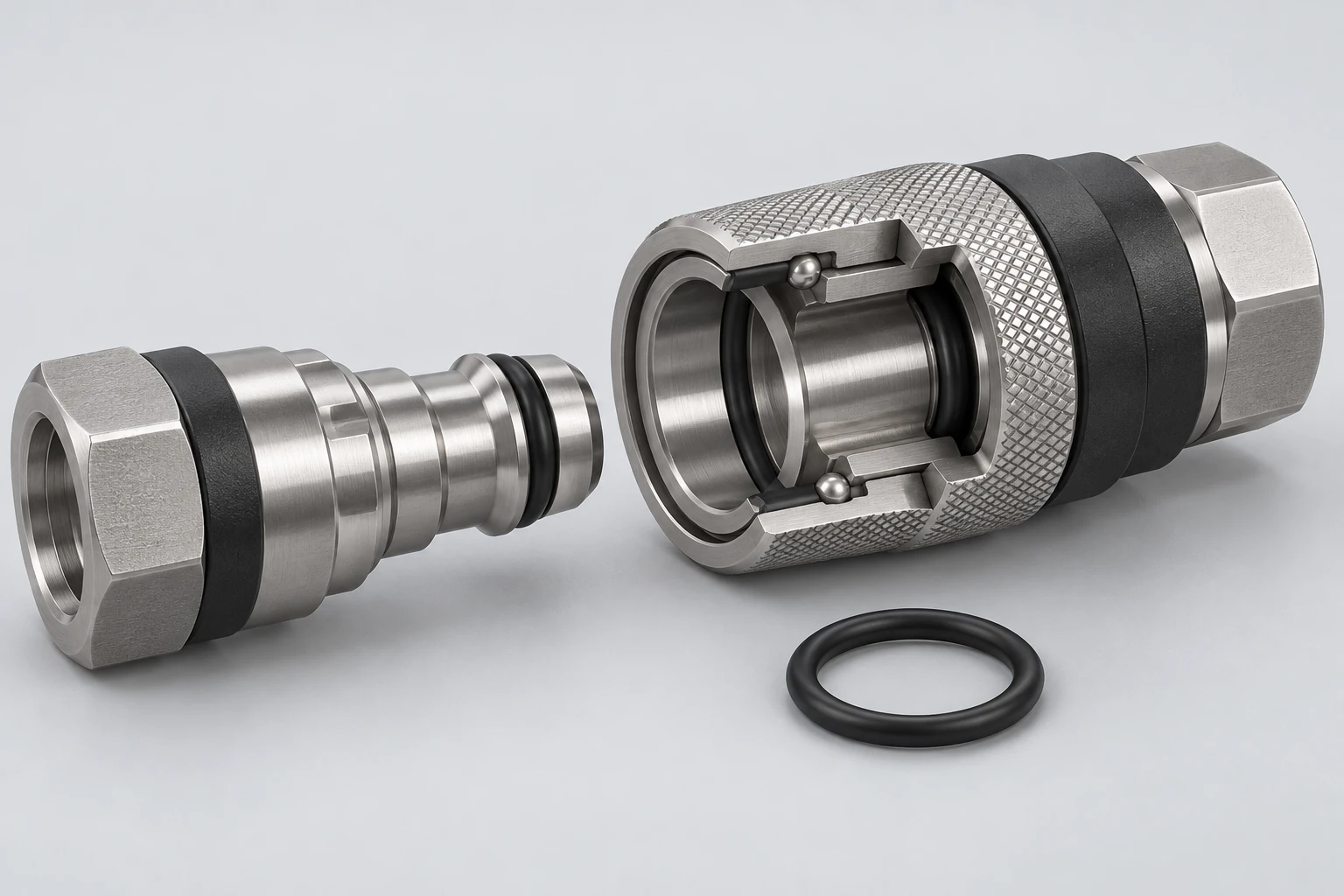
A liquid-cooled AI server links cold plates, hoses, quick disconnects, manifolds and a coolant distribution unit (CDU). A connector is one small part of that loop, but its seals and assembly conditions deserve their own review.
Start with the connector maker’s specification. Where assembly lubrication is permitted, evaluate the lubricant together with the actual seal compound and coolant. The correct choice depends on the specific assembly.
Separate the O-ring assembly surface, moving mating surfaces and any wetted area. Identify where a lubricant may be used and where migration must be controlled.
Record the coolant product and concentration, elastomer compound, metals and polymers. A material name alone does not establish compatibility with every coolant formulation.
Agree on connection and disconnection force, sealing criteria, operating temperature and pressure, and connection cycles. Compare candidates under matching assembly conditions.
After coolant exposure and cycling, inspect seal dimensions and condition, connection force, leakage and deposits. Use the component and coolant suppliers’ acceptance criteria.
Connector model or drawing, seal compound, coolant identification and the current assembly method.
Confirm permitted lubrication locations, dose and cleanliness requirements with the connector manufacturer.
Keep application location and quantity consistent; record the initial state and the state after exposure and cycling.
Bring the results back to the assembly specification. A coupon test or a lubricant data sheet alone does not establish qualification of a complete cooling loop.
Follow the connector manufacturer’s assembly specification. Some interfaces have a defined lubricant and dose; others have different requirements. Confirm the design before changing the process.
Review the exact approval scope and the actual coolant formulation separately. A water-contact approval does not establish compatibility with all coolant additives or seal compounds.
Evaluate the actual compound, coolant and operating conditions. Elastomer family names help define the test, but they are not a universal compatibility verdict.
Share the component, present lubricant or assembly process, coolant details and test targets. EUBO can discuss candidate materials and an evaluation approach; grade-specific properties and suitability require current documents and actual-component testing.
Public engineering background; these references do not indicate approval or endorsement of an EUBO product.
LIQUID-COOLING CONNECTORS & SEALS
Define whether lubrication is needed and which surfaces contact coolant, then evaluate the fluid, seal material and actual assembly.
Application evaluation: confirm material suitability on the specific connector with its actual coolant and seal materials.
Evaluation inputs
Evaluation inputs
Evaluation inputs